
Bitcoin's next move: Will a potential rate cut this week spark a surge?
.png)
Bitcoin’s recovery back towards $92,000 has arrived at a pivotal moment, with traders weighing whether the Federal Reserve’s anticipated rate cut could ignite the market’s next decisive move. The rebound from December’s $82,000 trough has steadied sentiment after October’s $19 billion leverage wipeout, yet liquidity remains thin and order books fragile.
A cut would lower funding costs and could reawaken dormant risk appetite, but Bitcoin’s recent price action suggests investors are still navigating the aftershocks of tightening policy and inconsistent inflation data. With jobless-claim forecasts rising and quantitative tightening now concluded, this week’s decision may determine whether Bitcoin breaks out of its narrow range - or continues to drift until liquidity returns.
What’s driving Bitcoin’s move?
Bitcoin has climbed to around $91,550 after reclaiming the $90,000 handle over the weekend, supported by a tentative shift in macro expectations. Traders remain cautious after October’s sudden $19 billion leverage purge, which erased order-book depth and exposed structural fragilities across major exchanges.
Market makers have been slow to return, a hesitation that has kept price action contained even as broader risk sentiment improves. The end of quantitative tightening on 1 December has further strengthened expectations for a rate cut, particularly as economists forecast a 30,000 rise in initial jobless claims this week.
This realignment is happening against the backdrop of historic capital inflows into Bitcoin. Glassnode’s Q4 Digital Assets Report shows that the 2022–2025 cycle has attracted $732 billion in net inflows - more than all previous cycles combined.
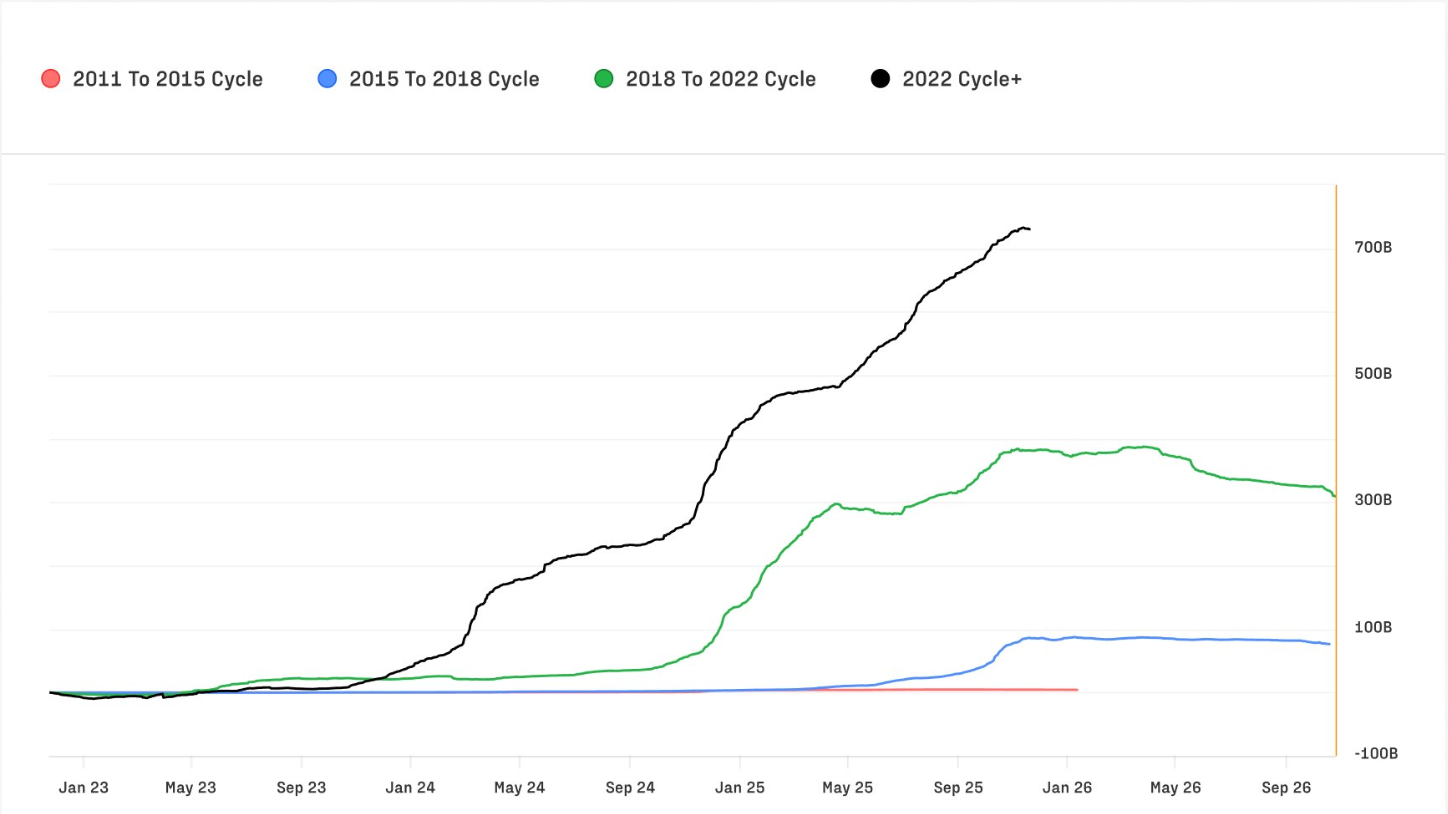
Monthly inflows, which peaked at nearly $40 billion in October, have since cooled to around $15 billion but remain structurally significant. Realised Cap has reached a new all-time high of $1.1 trillion, signalling long-term confidence even as short-term volatility contracts.
Why it matters
As Bitcoin becomes increasingly institutional, its sensitivity to global rate expectations has intensified. Michael Wu, CEO of Amber Group, notes that shifts in rate guidance “ripple through crypto funding markets in Asia far more quickly than traditional asset classes,” with funding spreads and borrowing costs adjusting almost instantly to central bank signals. This tightening correlation has prompted trading desks to diversify liquidity across CeFi and DeFi venues, a strategic response to heightened volatility and thinner market depth.
Inflation dynamics add another layer of complexity. Services inflation has cooled from its peaks but remains firmer than goods, and shelter continues to run above the Fed’s target. That uneven progress complicates the central bank’s disinflation effort and keeps markets uncertain about the pace and depth of future rate cuts.
Gold and silver have surged on this uncertainty, while Bitcoin - which remains more sensitive to liquidity shocks than equities - has struggled to break out. Bloomberg’s Mike McGlone argues that Bitcoin often underperforms the S&P 500 when equity volatility rises, citing ongoing realignment in risk preferences. His perspective aligns with a broader theme: Bitcoin’s trajectory is increasingly shaped by macroeconomic conditions rather than crypto-native catalysts.
Impact on markets and investors
The October liquidation shock has left a long shadow. Ryan McMillin of Merkle Tree Capital describes a market where “order books were wiped out” and liquidity has yet to recover fully. This fragility amplifies the impact of macroeconomic data releases, resulting in sharper intraday moves and a narrower trading corridor. Even if a rate cut is announced, the absence of deep liquidity may temper any initial rally, turning it into a gradual grind rather than a straight breakout.
Institutional positioning reinforces this dynamic. Bitcoin’s dominance has risen from 38.7% to 58.3% since late 2022 - a pivot towards higher-liquidity assets as retail speculation declines. Ethereum’s share has slipped to 12.1%, extending its multi-year underperformance since the 2022 Merge.
Stablecoins now make up 8.3% of the market and remain the core settlement layer across both centralised and decentralised venues, especially in emerging markets. Long-term volatility has decreased from 84% to 43%, indicating that market depth and institutional weighting are stabilising the asset, even if short-term swings remain outsized.
This contrasts sharply with more ideological narratives circulating in the ecosystem. Michael Saylor, adopting a geopolitical frame, has argued that the United States should accumulate Bitcoin before rivals, warning they would otherwise “buy it back at $50 million a coin”. While this reflects the extreme bullish sentiment that periodically captures market attention, it stands apart from the macro and liquidity considerations guiding near-term price action.
Expert outlook
The immediate question is whether a rate cut can trigger a decisive breakout. Lower borrowing costs typically support risk-taking and may encourage market makers to scale back in. McMillin believes the conditions are already improving following the end of quantitative tightening, suggesting that “the market is set to rally,” with a cut potentially acting as the catalyst. Still, many desks remain cautious, mindful that liquidity may take months to rebuild. As a result, any post-cut rally may unfold in stages, rather than erupt in a single move.
Longer-term indicators remain supportive. Record capital inflows, rising Realised Cap, and a structural decline in volatility all point to a more resilient market than in past cycles. Yet Bitcoin’s next phase depends on how macro conditions evolve. Traders will focus on the Fed’s policy statement, jobless claims data, and equity volatility to gauge whether a sustainable trend can emerge. A break above recent highs is possible, but only if liquidity rebuilds and funding conditions continue to soften. For now, Bitcoin’s climb back above $90,000 represents the beginning of a transition rather than a confirmed shift in regime, according to analysts.
Key takeaway
Bitcoin’s climb back above $90,000 comes at a critical juncture, with the Federal Reserve poised to shape its next major move. A rate cut could ignite a rally, but thin liquidity and cautious market makers may restrain the initial response. Structural data remains bullish; however, the market’s near-term path hinges on macroeconomic signals rather than crypto-specific momentum. The next clues will come from the Fed’s tone, trends in jobless claims, and the pace at which liquidity returns.
Technical analysis
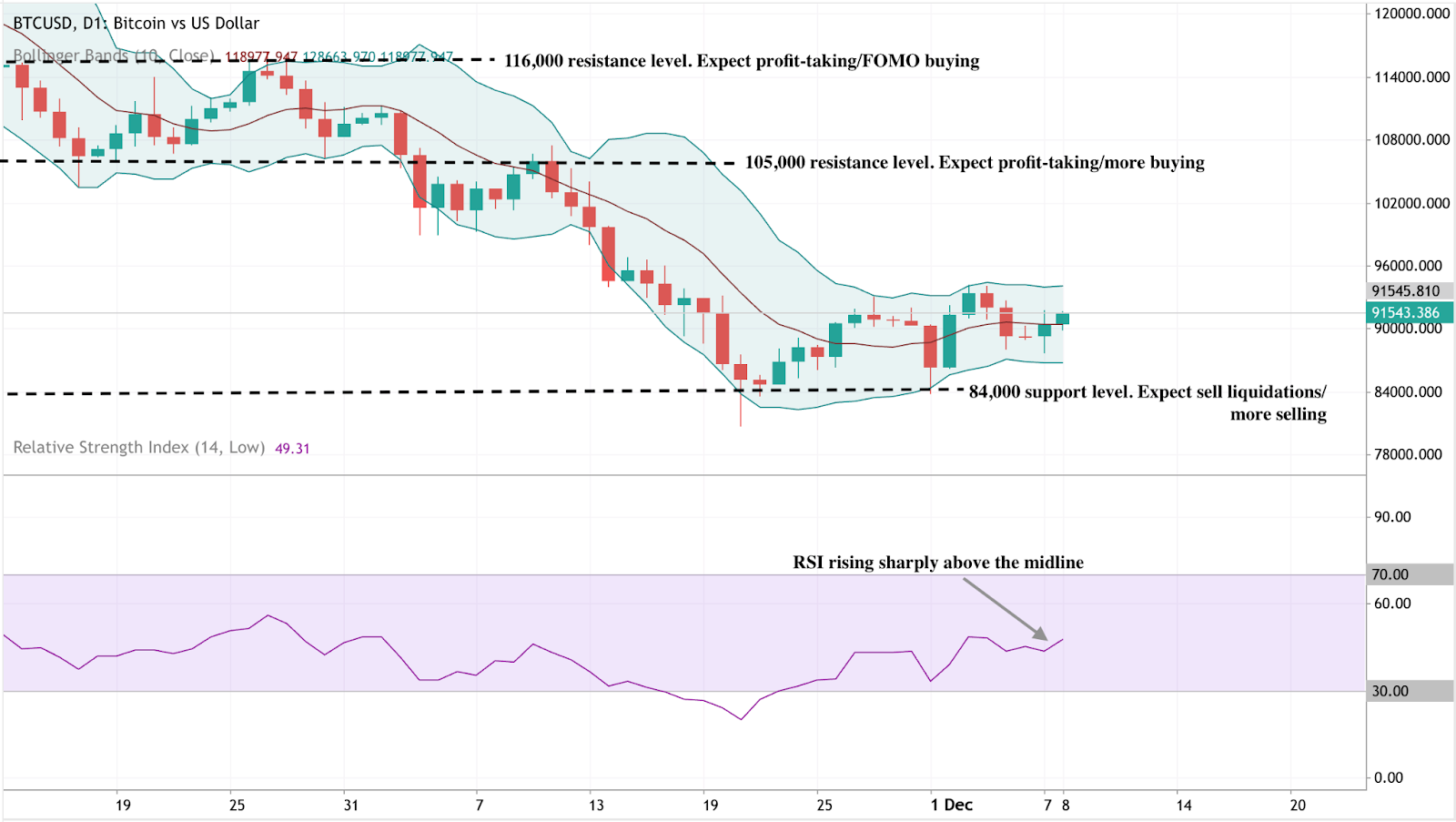
At the time of writing, Bitcoin (BTC/USD) is trading near $91,545, continuing to stabilise above the key $84,000 support level. This zone remains crucial; a decisive break below it would likely trigger sell-side liquidations and extend the broader downtrend. On the upside, BTC faces resistance at $105,000 and $116,000, areas where traders typically anticipate profit-taking or the return of FOMO-driven buying if momentum strengthens.
Price action reflects a tentative recovery. BTC is holding within the mid-section of its Bollinger Band range after several weeks of heavy downside pressure, a sign that sentiment is improving even if conviction remains limited. The RSI near 49 has risen sharply from earlier lows and now sits just above the midline. This signals a shift in momentum as sellers lose dominance, though it also indicates that Bitcoin has not yet entered strong bullish territory. A sustained push higher will likely depend on the market’s ability to form higher lows and build pressure toward the $105,000 resistance.
The performance figures quoted are not a guarantee of future performance.
The future performance figures quoted are only estimates and may not be a reliable indicator of future performance.


