
USD/JPY forecast: Can a strong economy survive prolonged dovishness?

Analysts say Japan’s economy can sustain its current momentum under prolonged dovish policy - but not indefinitely. Growth remains steady, inflation has stayed above the Bank of Japan’s 2% target for more than three years, and exports are finally recovering.
Yet, the BoJ’s slow path toward tightening and a new government’s focus on fiscal stimulus are testing how much patience markets can bear. With the USD/JPY pair holding near 152, traders are weighing whether Japan’s strong fundamentals can coexist with a weak currency, or if policy divergence with the U.S. will soon push the pair toward 160.
Key takeaways
- Japan’s trade deficit narrowed slightly to ¥234.6 billion in September from ¥242.8 billion in August, suggesting export momentum but missing forecasts for a surplus.
- Exports rose 4.2% YoY, the first increase since April, while imports surged 3.3%, their first gain in three months.
- A Reuters poll found 96% of economists expect BoJ rates to reach 0.75% by March 2026, with 60% predicting a 25 bps hike this quarter.
- Sanae Takaichi’s election as Japan’s first female Prime Minister spurred equity gains and Yen weakness as markets priced in more fiscal stimulus and delayed BoJ tightening.
- The USD/JPY pair hovers near 152, supported by Fed rate-cut expectations and broad uncertainty over Japan’s policy direction.
Japan fiscal stimulus optimism vs. fiscal constraints
The election of Sanae Takaichi marks a historic milestone - Japan’s first female Prime Minister - and a clear policy inflection point. Takaichi’s platform emphasises economic revitalisation, defence investment, and stronger U.S. relations, signalling a government ready to spend.
Her coalition, formed with the Japan Innovation Party, promised fiscal stimulus to drive growth - echoing elements of Abenomics.
The Japan 225 has rallied nearly 13% since early October, briefly nearing the 50,000 level before profit-taking set in.
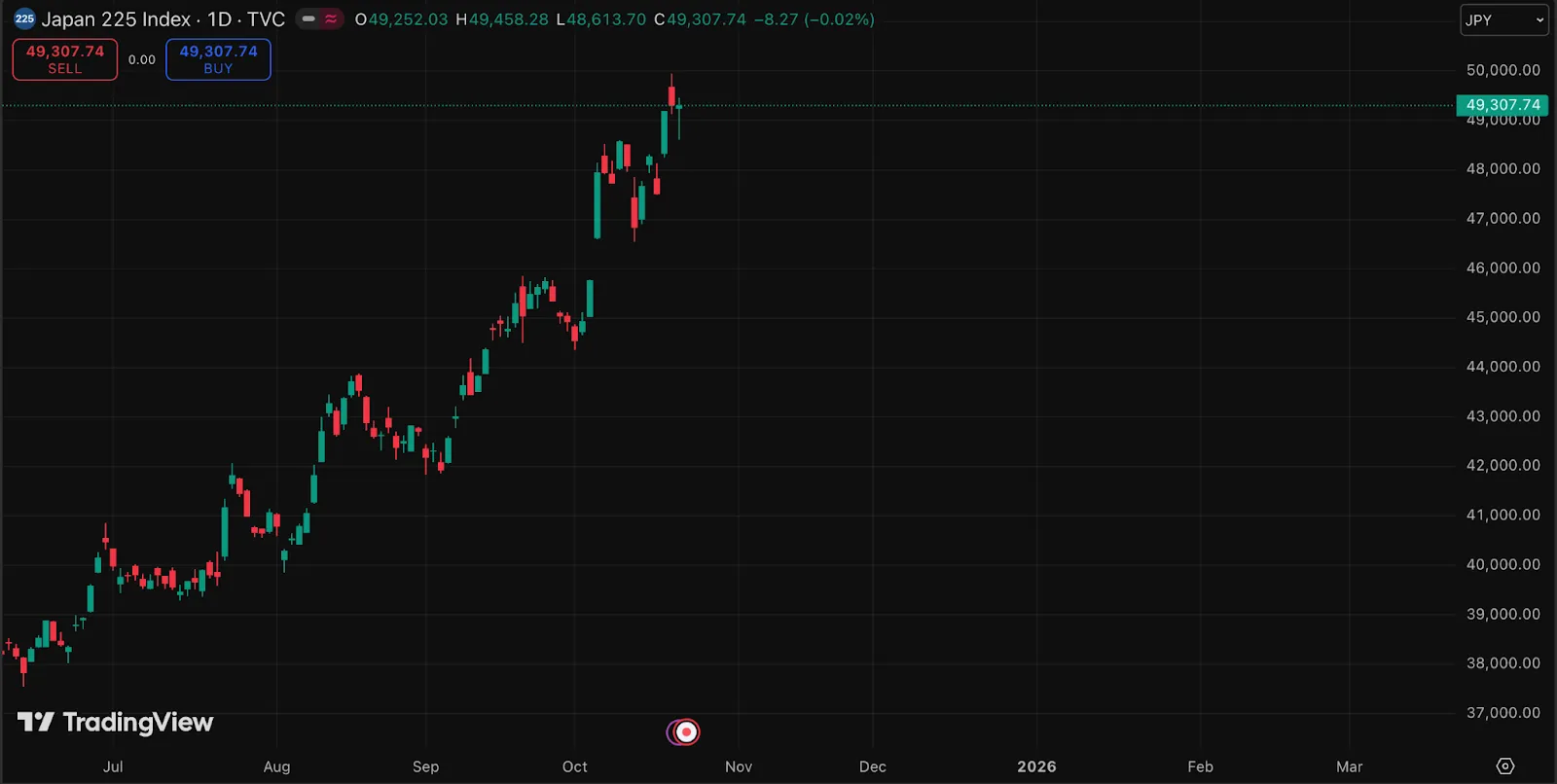
Yet, optimism about stimulus-led growth has simultaneously pressured the Yen, with traders anticipating a delay in BoJ normalisation. Still, Takaichi’s administration faces constraints.
The coalition’s 231 seats in the lower house fall short of the 233 needed for a majority, forcing her to rely on opposition support to pass legislation. This weak parliamentary position limits the scale of fiscal expansion and injects political uncertainty into Japan’s economic outlook.
Bank of Japan interest rates: Resilience defies policy inertia
Japan’s macro picture has turned unexpectedly robust.
- The trade deficit narrowed for a second month, driven by improved export performance and moderating import costs.
- Exports rose 4.2% year-on-year, marking their first increase since April, supported by demand from Asia and Europe.
- Imports jumped 3.3%, their strongest gain in eight months, reflecting solid domestic consumption and higher energy costs.
Meanwhile, Japan’s GDP has expanded for five straight quarters, confirming a durable recovery from 2023’s stagnation.

Inflation remains above 2%, supported by rising wages and service-sector demand. These conditions would trigger tightening in any other major economy.

Yet, despite these fundamentals, the BoJ remains the only major central bank still below 1% policy rates. Deputy Governor Shinichi Uchida has reaffirmed that future hikes will depend on “sustainable inflation trends,” while Board Member Hajime Takata stated that Japan has “roughly achieved” its price target - signalling cautious optimism but not urgency.
This mismatch between strong economic data and hesitant policy is keeping the Yen under pressure, as investors look elsewhere for yield.
BoJ’s policy rate: The slow road to 0.75%
The market expects change - just not quickly. According to a Reuters survey, 64 of 67 economists (96%) forecast the BoJ’s policy rate will reach 0.75% by March 2026, with 45 of 75 respondents (60%) expecting a 25 bps rate hike this quarter.
That timeline underscores just how gradual BoJ normalisation will be. The BoJ’s strategy hinges on ensuring wage gains are durable and not merely the result of cost-push inflation. But the risk is that patience turns into policy inertia, leaving the Yen vulnerable to capital outflows if other central banks ease faster.
Across the Pacific: Fed cuts, fiscal chaos, and Dollar fatigue
The U.S. Dollar Index (DXY) trades near 98.96, sliding after a brief recovery. A looming U.S. government shutdown, now in its fourth week, has frozen key data releases and clouded Fed visibility. The Senate has failed 11 times to pass a funding bill, making it the third-longest shutdown in U.S. history.
The CME FedWatch Tool now prices in a 96.7% chance of a rate cut in October and a 96.5% chance of another in December.

Fed officials are leaning dovish:
- Christopher Waller supports another immediate cut,
- Stephen Miran argues for a more aggressive 2025 easing path, and
- Jerome Powell confirmed the Fed is “on track” for another quarter-point reduction.
With the U.S. economy slowing, the rate differential between Japan and the U.S. is narrowing, making the Dollar less dominant. A faster Fed pivot could therefore cap USD/JPY upside, even without BoJ intervention.
USD JPY technical insight: Between fiscal hope and policy drag
The appointment of Finance Minister Satsuki Katayama - known for favouring a stronger Yen and calling 120–130 per USD “fundamentally justified” - has introduced a more balanced tone. However, broader market positioning still leans toward Yen weakness.
Analysts at Commerzbank note that the new government’s business-friendly orientation is unlikely to support long-term depreciation, projecting sideways USD/JPY movement as Japan’s fiscal push and BoJ patience offset one another.
After three consecutive sessions of losses, the Yen strengthened slightly midweek following the trade data release. The USD/JPY pair pulled back modestly but remains near 151.84. A bullish move is likely to meet resistance at the 153.05 price level, with RSI showing strengthening buy momentum. Conversely, if sellers prevail, they are likely to find support at the 150.25 and 146.70 price levels.

Traders can track these levels in real time using Deriv MT5 and may consider placing stop-loss orders near the 150.25 support zone to manage risk in this volatile pair. Using Deriv’s economic calendar helps anticipate BoJ or Fed announcements that typically move the Yen.
Market impact and trading implications
For traders, USD/JPY presents a rare balance of risk and reward.
- Upside case: If BoJ delays tightening while the Fed stays cautious, USD/JPY could retest 158–160, testing market tolerance for Yen weakness.
- Downside case: If the Fed cuts twice and BoJ delivers even a modest hike, the pair could retrace to 145–147, unwinding part of 2024’s rally.
The carry trade remains a major driver of Yen sentiment. As global investors continue borrowing in Yen to fund higher-yield positions in other currencies, Japan’s low interest rates sustain the JPY’s role as a global funding currency. Any shift in BoJ policy or sudden increase in market volatility could force carry-trade unwinding, triggering rapid Yen appreciation.
The near-term tone remains range-bound, but volatility risk is high as politics and policy pull in opposite directions. Equity traders may find support in Japan’s stimulus agenda, while currency traders should prepare for potential BoJ recalibration before mid-2026.
Ultimately, Japan’s strong economy is proving resilient - but its currency may not stay patient forever. The question for 2025 is no longer whether Japan can grow, but how much dovishness its strength can bear before markets force the BoJ’s hand.
The performance figures quoted refer to the past, and past performance is not a guarantee of future performance or a reliable guide to future performance.
The future performance figures quoted are only estimates and may not be a reliable indicator of future performance.


