
Santa Claus rally 2025: Will the stock market get a gift?
.png)
It is December 2025. The Fed has just cut interest rates for the third time, but the S&P 500 is stumbling. Traders are asking one question: Is the holiday party cancelled?
Every year around this time, Wall Street turns its attention to one of the market’s most festive - and oddly persistent - seasonal patterns: the Santa Claus rally. It’s a short window, steeped in market folklore, that has a habit of stirring optimism just as liquidity thins and investors close the books on the year.
But with economic data softening and equity leadership narrowing, Santa’s arrival this year feels less certain.
What is the Santa Claus rally?
The Santa Claus rally refers to a seven-trading-day period covering the final five trading days of December and the first two trading days of January. According to the Stock Trader’s Almanack, this window has delivered an average gain of around 1.2–1.3% for the S&P 500 since 1950 - a stronger return than the average for most months of the year.
The pattern was first identified in 1972 by Yale Hirsch, founder of the Almanac, and has since become a closely watched seasonal tendency rather than a guaranteed outcome.
In 2025, the Santa Claus rally window runs from Wednesday, 24 December, through Monday, 5 January.
Why markets often rally at year-end
There’s no single reason behind the Santa Claus rally, but several forces tend to align at the same time:
- Holiday optimism improves investor sentiment
- Year-end bonuses flow into financial markets
- Tax-loss selling fades, reducing downward pressure
- Institutional investors step back, leaving lighter volumes
- Expectations reinforce behaviour, creating a self-fulfilling effect
With thinner liquidity, even modest buying can have a disproportionately large impact - particularly in major indices.
When Santa doesn’t show, bears sometimes do
The Santa Claus rally carries an outsized reputation because of what it’s thought to signal when it fails.
An old Wall Street saying warns:
“If Santa Claus should fail to call, bears may come to Broad and Wall.”
History suggests the relationship is far from perfect. Since 1969, there have been 14 years when the S&P 500 delivered negative returns during the Santa window. In those cases, the market finished the following year lower only four times, making the indicator more of a sentiment gauge than a forecasting tool.
Still, the rally itself has shown up around 76% of the time since 2000, far better odds than a random seven-day trading period.
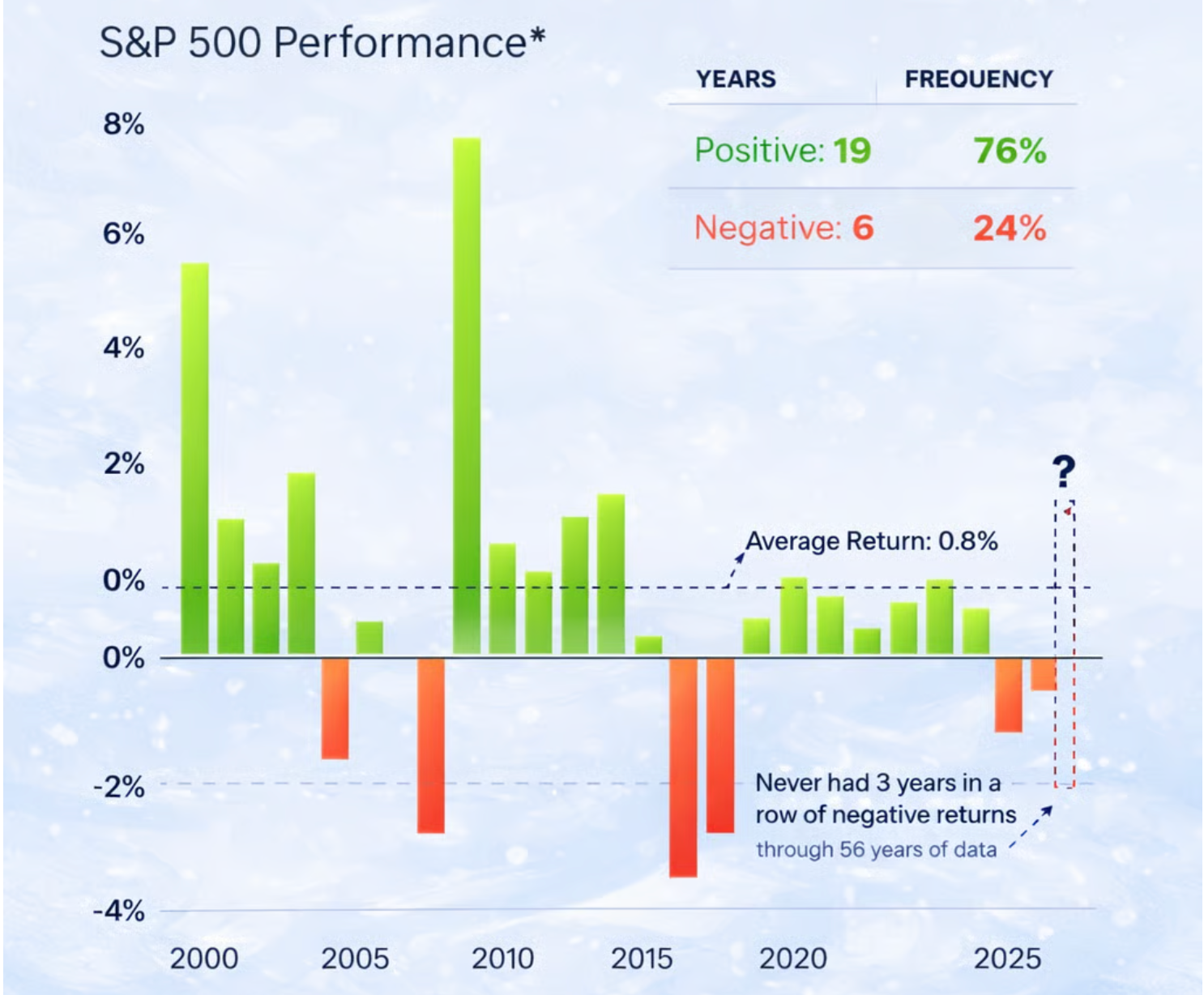
This year’s backdrop is unusually mixed.
On one hand, US jobs data has softened, hinting that economic momentum may be slowing. Market gains remain heavily concentrated in a handful of mega-cap stocks, increasing the risk of sharper pullbacks if sentiment shifts.
On the other hand, the Federal Reserve is firmly in easing mode.
With three rate cuts already delivered and futures markets pricing in at least two more in 2026, financial conditions are becoming increasingly loose. History shows that betting against the Fed is rarely a winning strategy, particularly during periods of low liquidity, such as year-end.
That monetary tailwind could be enough to support a late-year lift - even if confidence remains fragile.
Santa is festive, not flawless
Seasonality is helpful, but it isn’t destiny.
The Santa Claus rally failed to materialise in 2023 and 2024, and last year the S&P 500 slipped during the festive window. In contrast, from 2016 to 2022, the market experienced growth every year, with gains exceeding 1% in several instances.
Even in years when the broader market finished lower, the Santa window often still delivered gains. In down years since 1969, the median Santa rally return was roughly 1.3%, despite double-digit declines over the full year.
In short, Santa may be unreliable - but historically, he’s turned up more often than not.
One asset to watch: Gold
While the Santa Claus rally traditionally focuses on equities, gold may be the more interesting asset to watch this year. According to analysts, rate cuts tend to compress real yields and soften the US dollar, two conditions that have historically supported gold prices. With the Fed easing and inflation risks still lingering beneath the surface, the macro backdrop is quietly becoming more favourable for the yellow metal.
From a technical perspective, gold has shown resilience rather than weakness. Prices have held above key medium-term support levels despite equity volatility, suggesting that dips continue to attract buyers rather than trigger panic selling.
If risk sentiment improves into year-end, gold could grind higher alongside equities. If equities falter or volatility spikes, gold may benefit from defensive flows instead. Either way, it provides traders with a means to express the same macro view without relying solely on stock market direction.
So is Wall Street getting a gift or the Grinch?
That remains the question.
The Santa Claus rally is not a crystal ball, and it won’t erase concerns around slowing growth, valuation, or market concentration. But history suggests that dismissing it entirely has often been costly.
With the Fed easing, liquidity thinning, and sentiment delicately balanced, analysts expressed the odds still lean towards a late-year move - even if it proves short-lived. Whether Wall Street unwraps a gift or gets a lump of coal, Santa’s window is open - and the market is watching closely.
Expert outlook: Why gold may steal Santa’s spotlight
While equity investors debate whether Santa shows up, gold may not need the invitation. Easing monetary policy, softer real yields, and ongoing macro uncertainty create a backdrop where gold can perform regardless of whether equities rally or retreat. Year-end liquidity conditions may further amplify market movements, particularly if US dollar volatility increases.
For traders, the focus remains on:
- Key support zones near recent breakouts
- RSI holding above neutral, signalling trend stability
- US dollar direction during thin holiday trading
- Gold doesn’t rely on festive optimism - it thrives on uncertainty.
Key takeaway
The Santa Claus rally is a seasonal tendency, not a promise. This year, its fate rests on the balance between easing monetary policy and fragile market confidence. Market watchers highlighted that if equities rally, it could reinforce bullish momentum into early January. If they don’t, assets like gold may take centre stage as investors turn defensive. Either way, year-end is shaping up to be less about blind optimism and more about positioning, selectivity, and risk management.
Gold technical insights
Gold remains in a strong bullish trend, with price trading near the upper Bollinger Band, signalling sustained upside momentum but also increasing the risk of short-term consolidation. The steady expansion of the bands suggests volatility remains supportive of the broader uptrend.
On the downside, $4,035 is the first key support, followed by $3,935, where a break could trigger sell-side liquidations and a deeper corrective move. Momentum remains elevated, with the RSI rising into overbought territory, indicating strength but also warning that upside gains may slow without a pullback.

The performance figures quoted are not a guarantee of future performance.


