
How Deriv’s Tactical Indices help silver traders in volatile markets

Silver’s volatility often reflects sudden shifts in trader sentiment — momentum builds quickly, then reverses just as fast. The Relative Strength Index (RSI) tracks these changes by showing when momentum is stretching or fading. By linking RSI behaviour to automated trading rules, Deriv’s Tactical Indices turn unpredictable swings into structured opportunities, helping traders act consistently rather than react impulsively.
Quick summary
- What Deriv is today: Multi-platform provider (Deriv MT5, Deriv cTrader) with long experience in Derived and Synthetic markets.
- What Tactical Indices do: Four RSI-based strategies — Trend Up, Trend Down, Pullback, Rebound — automate exposure to momentum and reversals.
- Why it matters: Silver’s extreme volatility rewards systematic execution over ad-hoc timing.
- How to start safely: Trade first in demo on Deriv MT5 or Deriv cTrader; go live with position sizing, diversification, and equity caps.
- What’s next (planned): MACD/Bollinger variants, broader assets, and in-platform analytics (drawdowns, Sharpe).
How does an RSI strategy support silver trading in volatile markets?
Silver has repeatedly swung between multi-decade highs and sharp corrections driven by shifting inflation, interest-rate expectations, and global demand.
Reacting fast and consistently is hard; Deriv Tactical Indices automate key RSI-based decisions, allowing traders to engage with silver’s momentum systematically.
What makes Deriv’s RSI trading strategies different from others?
Founded in 1999, Deriv built its reputation on Derived and Synthetic markets available via Deriv MT5 and Deriv cTrader.
Silver’s range expansions and reversions make manual timing unreliable, so Deriv embeds trading rules inside indices, allowing consistent execution without constant chart-watching.
How can automated trading improve silver CFD performance?
Deriv Tactical Indices belong to the Derived Indices family and automate RSI-based signals for silver CFDs. Traders choose an index type and size; the system manages timing, entries, and rebalancing.
Silver often reacts violently to macro triggers such as CPI data, dollar moves, or central-bank news. Manual traders may hesitate under pressure, while automated indices act instantly when RSI confirms a trend or reversal, reducing emotional bias and delay.
This helps traders capture large moves without constant monitoring. Automated execution also maintains discipline, aligns exposure with set risk limits, and supports steadier performance — key benefits for silver CFD trading as volatility persists.
Where do Deriv’s Tactical Indices fit within the Derived Indices family?
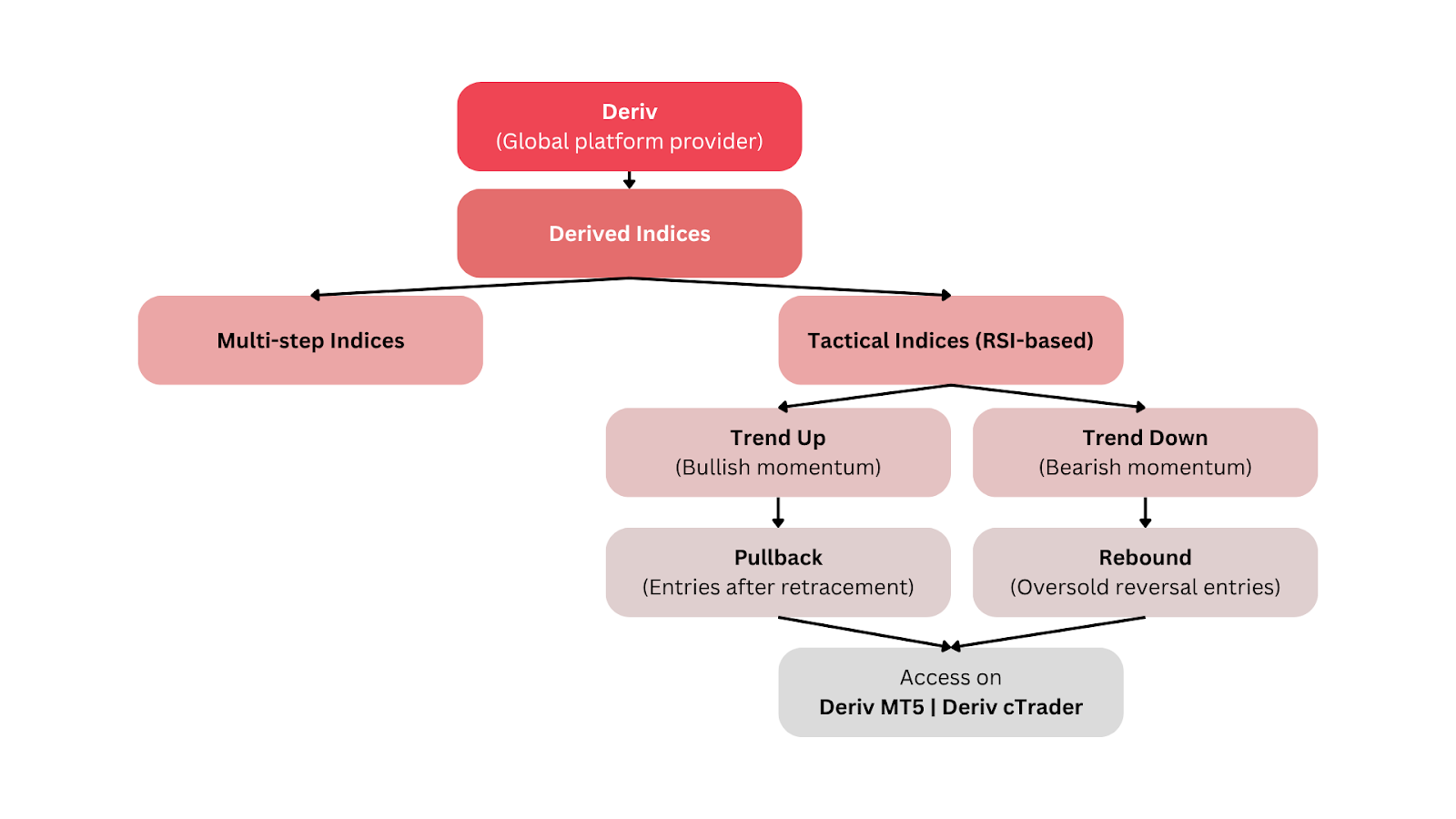
Deriv is the platform provider at the centre of this system. Within Deriv, Derived Indices simulate or mirror real-market behaviour. Tactical Indices are one subset — using RSI rules to automate silver trading decisions.
Available on Deriv MT5 and Deriv cTrader, they include four ready-made types:
- Trend Up – follows bullish momentum
- Trend Down – tracks bearish momentum
- Pullback – buys dips within an uptrend
- Rebound – captures recovery after oversold phases
Together, these tools give traders structured, ready-to-use automation without needing to code strategies.
How does the RSI strategy power each tactical index?
RSI converts recent average gains and losses into a 0–100 oscillator (typical 14 periods). ‘Overbought’ and ‘oversold’ usually sit near 70/30. In strong trends, RSI holds a zone instead of flipping extremes — the basis of Deriv’s indices.
In recent internal testing, Deriv’s strategists found that when silver’s RSI stayed above 50 for three sessions, Trend Up captured a larger share of the next move than discretionary entries.
“This validates disciplined, zone-based engagement over one-off threshold hits.” -Aisha Rahman, Senior Market Strategist
Index behaviours (compressed phrasing for clarity):
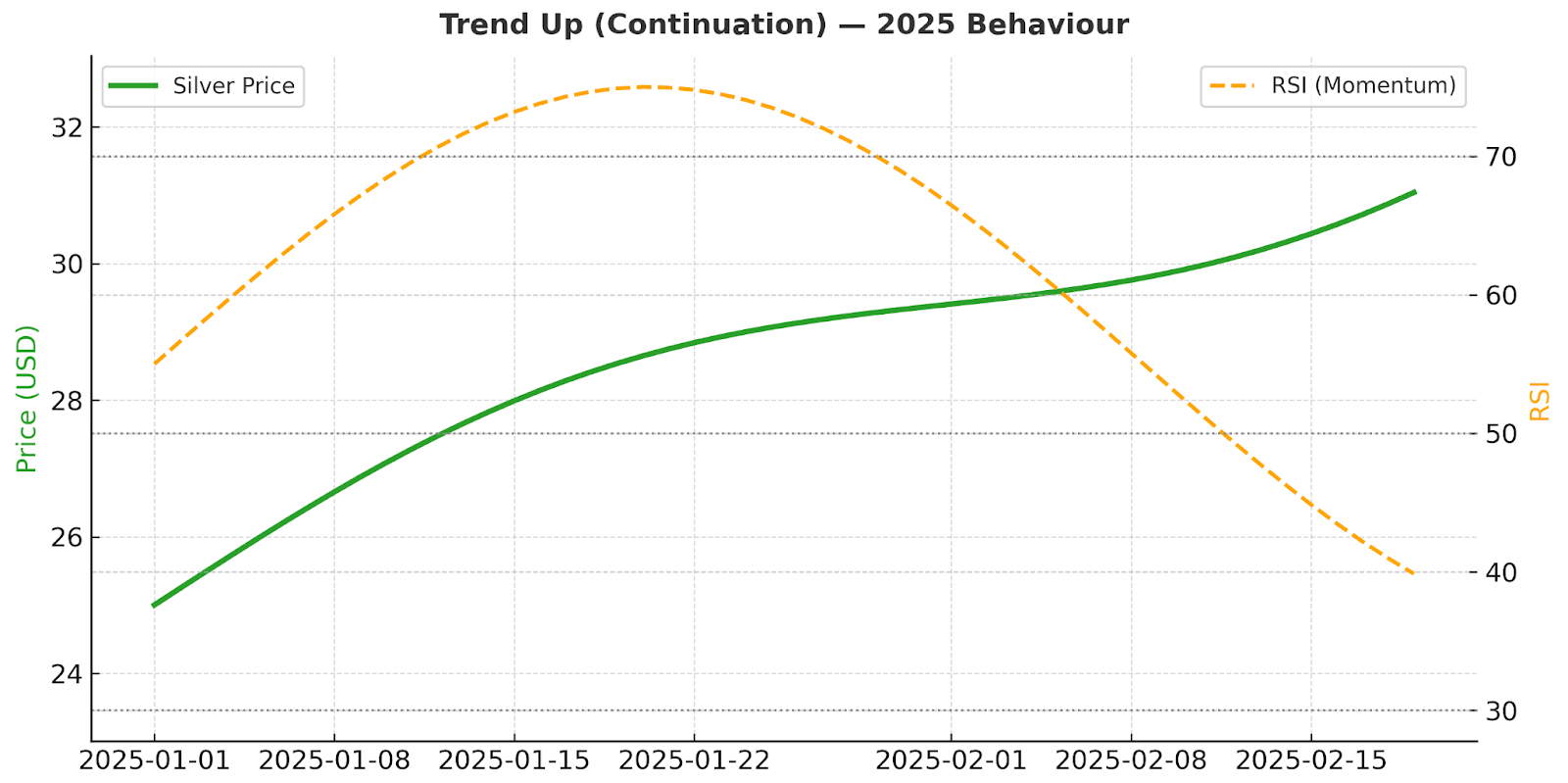
- Trend Up (continuation):
- Signal intent: Upside continuation when RSI >50 → 70 zone persists during bull legs.
- Confirmation: Higher highs/higher lows; pullbacks shallow; RSI dips hold above ~50.
- Hold/scale: Stay engaged while momentum holds; scale down if RSI slips towards ~50 and structure weakens.
- 2025 use: Trend days around CPI/NFP; more fragile in range-bound sessions.
- Trend Down (continuation):
- Signal intent: Downside continuation when RSI <50 → 30 zone persists in risk-off bursts.
- Confirmation: Lower highs/lower lows; failed rallies capped below ~50 RSI.
- Hold/cover: Maintain short until RSI reclaims ~50 with price strength.
- 2025 use: Dollar strength spikes, real-rate jumps, position de-risking.

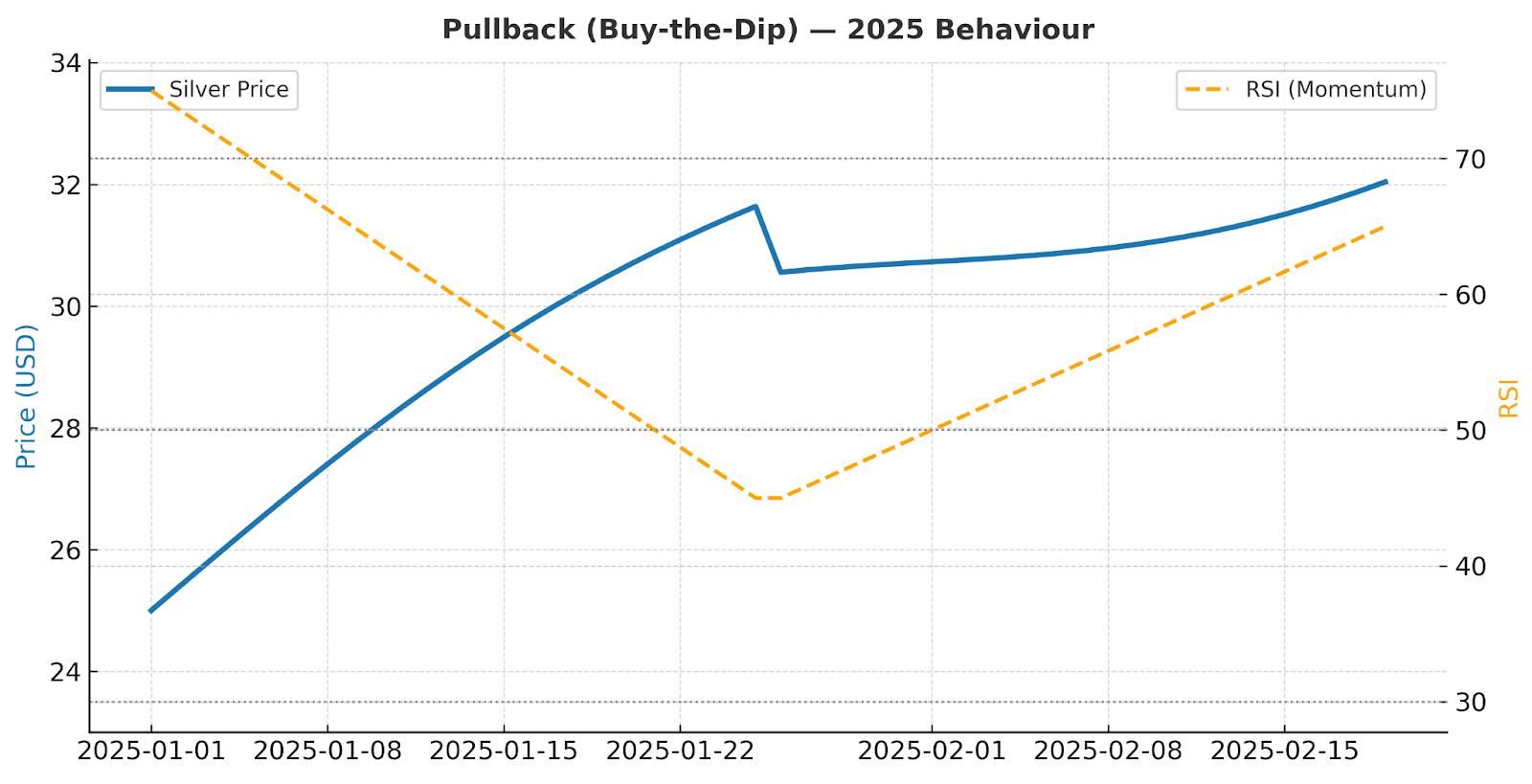
- Pullback (buy-the-dip):
- Signal intent: Overbought → neutral cooling (RSI 70 → 40–50), then re-engage long when momentum stabilises.
- Confirmation: Ends near prior breakouts/rising MAs; RSI turns up without losing the bullish range floor.
- Exit cues: RSI fails back to <50–60 or key supports give way.
- 2025 use: After extended rallies that often over-shoot then stabilise.
- Rebound (mean reversion):
- Signal intent: Washout to recovery (RSI <30 → 50), targeting early snapbacks.
- Confirmation: RSI crossbacks 30→40→50 with capitulation candles; price reclaims a short MA.
- Exit cues: RSI stalls below 50 or fresh lows print.
- 2025 use: Post-headline flushes; less effective if trend pressure persists.

Takeaway for 2025: Silver’s 30-day volatility has remained ≈34.7% in recent periods. Because swings are larger, zone-based RSI engagement tends to outperform isolated threshold hits; therefore, choose indices by regime, not by a single line-in-the-sand reading.
What past silver market moves reveal about volatility trading?
- 6 Nov 2024 – Post-election drop: Silver −5%; Trend Down +15%.
- 30–31 Oct 2024 – Data pullback: Silver −5.8%; Pullback +16%.
- 2–3 Dec 2024 – Rebound: Silver +3.5%; Rebound +12.7%.
- 9 Dec 2024 – Bullish run: Silver +4.5%; Trend Up +12.9%.
- Oct 2025 – Record highs: Silver ≈ $49.5/oz, RSI 82; Pullback likely as RSI cools to 60.
When silver trends, Trend indices capture continuation; after overshoots, Reversal indices often re-engage earlier than manual traders.
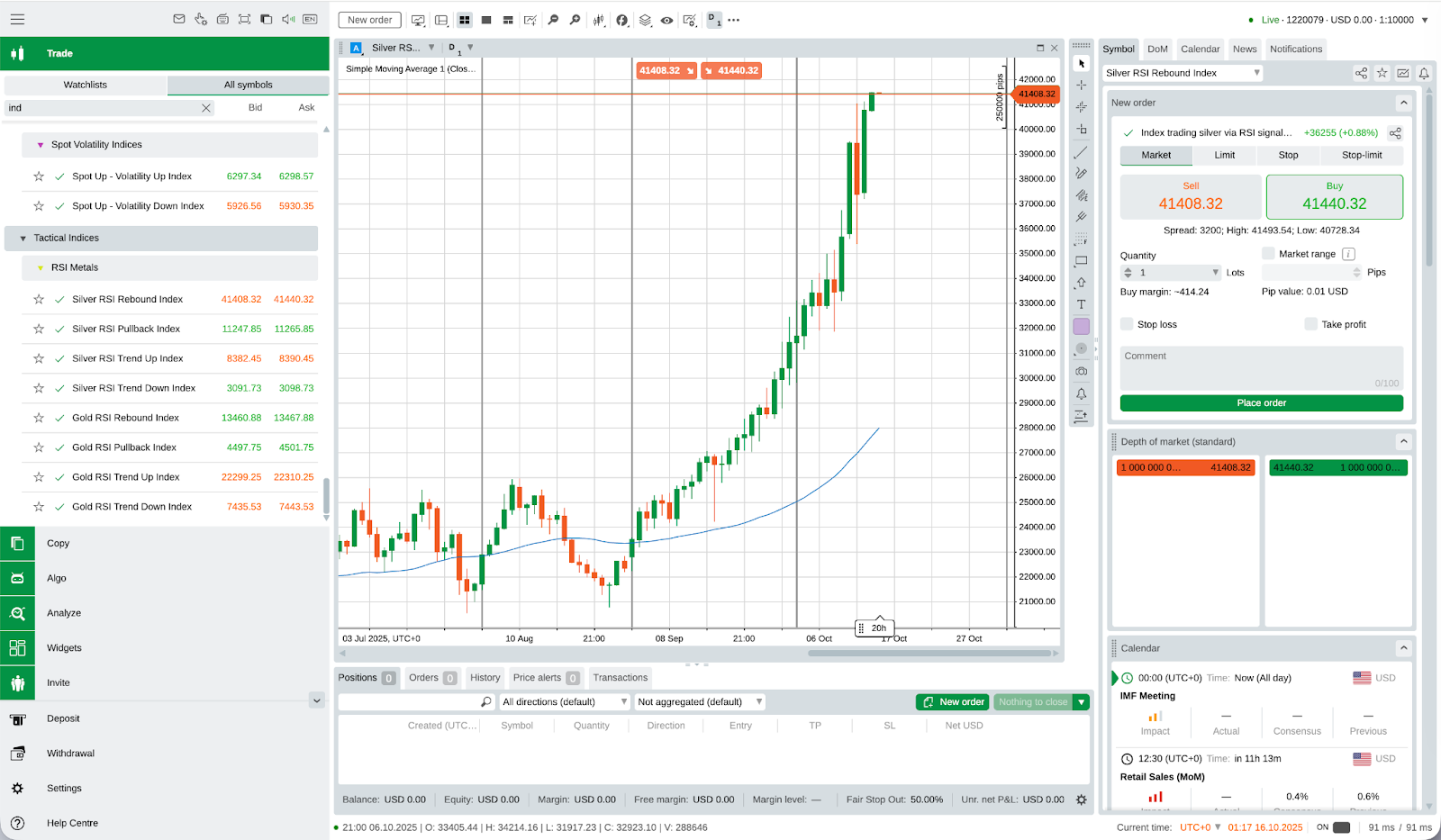
How do I access and use Tactical Indices on Deriv?
- Log in → Trader’s Hub.
- Choose Deriv MT5 or Deriv cTrader.
- Go Markets → Derived Indices → Tactical Indices.
- Select Trend Up/Down, Pullback, or Rebound.
- Review contract specs and set volume + optional stops/targets.
- Place order — note that rebalancing is built in.
- Keep a weekly log (moves captured vs spot, drawdown, hit rate by regime).
What are the key risk management practices in volatile markets?
- Position sizing: With $1,000 equity, risk 1–2% per trade; scale only after stable results.
- Leverage awareness: Silver CFDs (1:100) can magnify outcomes; reduce size near CPI/NFP/FOMC events.
- Equity caps: Set ≈ –3% daily stop to control shocks.
- Diversification: Mix Trend and Reversal indices; avoid single-strategy exposure.
- Process discipline: Review weekly (logs, RSI state, performance) to refine sizing and timing.
How does Deriv’s automated trading compare with IG and eToro?
Deriv targets active short-term silver trading via RSI automation, while IG and eToro focus on long-term investing.
What’s next for RSI trading strategies and volatility tools?
What’s planned next:
- New indicators: MACD (momentum), Bollinger Bands (volatility).
- More markets: Gold, FX pairs, equity indices.
- Analytics: Sharpe ratio & drawdown dashboards.
- Education: Deeper Deriv Academy integration for ‘learn → demo → live’.
How can traders start trading silver CFDs with Deriv’s Tactical Indices?
To deepen your knowledge, Derived Indices, and practical risk management.
If recent silver volatility has tested your discipline, try a systematic approach. Deriv’s Tactical Indices combine RSI logic with transparent automation so you can trade confidently without relying solely on instinct.
Start in demo on Deriv MT5 or Deriv cTrader, then move to live once you understand each index’s behaviour.
For deeper learning, visit the Deriv Academy for lessons on RSI, Derived Indices, and risk management.
Disclaimer:
The information contained within this blog article is for educational purposes only and is not intended as financial or investment advice.
This information is considered accurate and correct at the date of publication. Changes in circumstances after the time of publication may impact the accuracy of the information.
We recommend you do your own research before making any trading decisions.
Trading conditions, products, and platforms may differ depending on your country of residence. The content in this blog is not intended for EU residents.
The performance figures quoted refer to the past, and past performance is not a guarantee of future performance or a reliable guide to future performance.
The performance figures quoted are only estimates and may not be a reliable indicator of future performance.


