
Les métaux précieux sont-ils entrés dans un nouveau cycle de valeur refuge ?

Les métaux précieux sont-ils entrés dans un nouveau cycle de valeur refuge ? Les preuves semblent de plus en plus aller dans ce sens, selon les analystes. L’or a dépassé pour la première fois les 4 900 $ l’once, l’argent a atteint des sommets historiques au-dessus de 96 $, et le prix du platine a doublé en seulement sept mois. De tels mouvements d’ampleur se produisent rarement de façon isolée ou uniquement sur la base de la spéculation.
Ce qui distingue ce moment, c’est la synchronisation. Un dollar américain plus faible, la montée des risques géopolitiques, les anticipations de baisses de taux de la Federal Reserve et les achats constants des banques centrales vont tous dans le même sens. Lorsque l’or, l’argent et le platine réagissent ensemble au stress macroéconomique, cela signale souvent un changement de comportement plutôt qu’un simple rebond passager – soulevant la question de savoir si les métaux précieux retrouvent leur rôle d’actifs défensifs de base.
Qu’est-ce qui motive les métaux précieux ?
La récente envolée de l’or reflète un contexte macroéconomique familier mais qui s’intensifie. L’indice du dollar américain a reculé d’environ 0,4 %, améliorant l’accessibilité pour les acheteurs non-dollar, tandis que les marchés anticipent deux baisses de taux de la Federal Reserve au second semestre de l’année. Des rendements plus faibles réduisent le coût d’opportunité de la détention d’actifs non rémunérateurs, rendant l’or plus attractif au moment même où la confiance dans la stabilité monétaire commence à vaciller.
La géopolitique a ajouté une nouvelle couche d’urgence. Les tensions impliquant l’Iran et le Venezuela, ainsi que le regain d’incertitude autour du Groenland et des engagements de sécurité de l’OTAN, ont freiné l’appétit pour le risque.
Bien que les propos du président Trump sur le report de certains droits de douane européens aient brièvement calmé les marchés, le manque de clarté concernant les accords commerciaux et sécuritaires à long terme continue de soutenir les positions défensives. Comme l’a observé Peter Grant de Zaner Metals, la demande d’or reste étroitement liée à une tendance macroéconomique plus large de dédollarisation plutôt qu’à un seul choc d’actualité.
Pourquoi est-ce important
Ce rallye est significatif car il n’est pas uniquement alimenté par la spéculation des particuliers. Les banques centrales sont restées des acheteuses régulières d’or, renforçant son statut d’actif de réserve stratégique en période de tensions budgétaires et d’incertitude politique. Cette accumulation régulière a fourni un plancher de prix à long terme, même en cas de volatilité à court terme.
Le comportement de l’argent ajoute une autre dimension. Bien qu’il ne bénéficie pas du statut de réserve de l’or, il se situe à la croisée de la demande monétaire et industrielle. Nikos Tzabouras de Tradu note que l’argent profite toujours des flux de valeur refuge lors des périodes de faiblesse du dollar, même si son rôle industriel amplifie les variations de prix. Lorsque les deux métaux attirent simultanément des capitaux, cela suggère que les investisseurs se couvrent non seulement contre le risque de marché, mais aussi contre l’incertitude systémique.
Impact sur les marchés des métaux précieux
Derrière les prix affichés, la dynamique du marché physique se resserre. Stefan Gleason, PDG de Money Metals Exchange, décrit le trading actuel de l’argent comme inhabituellement intense, avec de nouveaux investisseurs entrant sur le marché tandis que les détenteurs de longue date prennent des bénéfices partiels. La demande des trois à quatre dernières semaines a dépassé les niveaux observés lors de la panique liée au COVID-19, malgré un doublement du prix de l’argent sur l’année écoulée.
La pression tient moins à la rareté de la matière première qu’à la capacité de traitement. Aux États-Unis, les grandes barres d’argent restent disponibles, mais la capacité limitée de raffinage et de frappe a créé des retards, des primes en hausse et des livraisons différées. Hors des États-Unis, la tension est plus marquée. Les marchés de Londres et d’Asie font face à une offre plus restreinte, aggravée par les flux vers les ETF qui ont retiré de l’argent physique de la circulation. En conséquence, les prix de l’argent en Asie se négocient désormais jusqu’à 3 $ au-dessus des niveaux de New York, un écart qui pourrait persister en raison des coûts de transport et des retards logistiques.
Le rôle du cuivre : un signal parallèle, pas une valeur refuge
Bien que le cuivre ne soit pas un actif refuge traditionnel, ni un métal précieux, son comportement récent renforce la tendance générale des matières premières. La demande de cuivre s’accélère à mesure que l’électrification, les investissements dans les énergies renouvelables et l’expansion rapide des centres de données pilotés par l’IA prennent de l’ampleur. À elle seule, l’infrastructure IA devrait consommer environ 500 000 tonnes de cuivre par an d’ici 2030, s’ajoutant à une demande déjà forte dans l’immobilier, les transports et les réseaux électriques, en particulier en Chine et en Inde.
Dans le même temps, la croissance de l’offre peine à suivre. Les perturbations minières au Chili et en Indonésie, la baisse de la teneur des minerais et la longueur des délais de mise en production – souvent près de deux décennies entre la découverte et l’exploitation – ont limité la production.
L’incertitude politique a ajouté une volatilité supplémentaire. Les droits de douane américains sur les produits semi-finis en cuivre, et la possibilité de taxes sur le cuivre raffiné à partir de 2027 en attente d’un examen du Commerce Department à la mi-2026, ont perturbé les flux commerciaux et poussé les stocks américains à leur plus haut niveau depuis plus de 20 ans. Si les perspectives du cuivre pour 2026 sont plus mitigées, avec des prévisions regroupées entre 10 000 $ et 12 500 $ la tonne, sa tension structurelle souligne le même thème que pour les métaux précieux : l’offre peine à répondre rapidement aux évolutions de la demande à long terme.
Perspectives des experts
D’un point de vue technique, la dynamique de l’or reste intacte, bien que la rapidité des gains augmente le risque de corrections à court terme. Grant estime que tout repli à court terme sera probablement perçu comme une opportunité d’achat, avec l’objectif des 5 000 $ l’once désormais clairement en vue et un potentiel de hausse supplémentaire selon les projections à long terme. La question clé n’est pas de savoir si la volatilité apparaîtra, mais si la demande l’absorbera.
Les perspectives du platine pourraient être encore plus sensibles. UBS prévoit désormais que le platine se négociera autour de 2 500 $ l’once dans les prochains mois, citant une forte demande d’investissement et des conditions physiques tendues. Avec une consommation annuelle de platine représentant une fraction de celle de l’or, même de modestes changements de préférence des investisseurs peuvent provoquer de fortes variations de prix. Des taux de location élevés à Londres témoignent d’une tension physique persistante, bien qu’UBS avertisse que la petite taille du marché pourrait maintenir la volatilité à un niveau élevé.
À retenir
Les métaux précieux semblent dépasser une simple hausse des prix pour entrer dans une phase de valeur refuge plus large. La progression de l’or vers 5 000 $, la tension sur le marché physique de l’argent et la rareté de l’offre de platine indiquent tous une réévaluation des actifs défensifs. Si la volatilité reste probable, les forces macroéconomiques sous-jacentes demeurent alignées. Les prochains signaux à surveiller seront les indications de la Federal Reserve, les flux vers les ETF et les primes physiques sur les principaux marchés mondiaux.
Perspectives techniques de l’argent
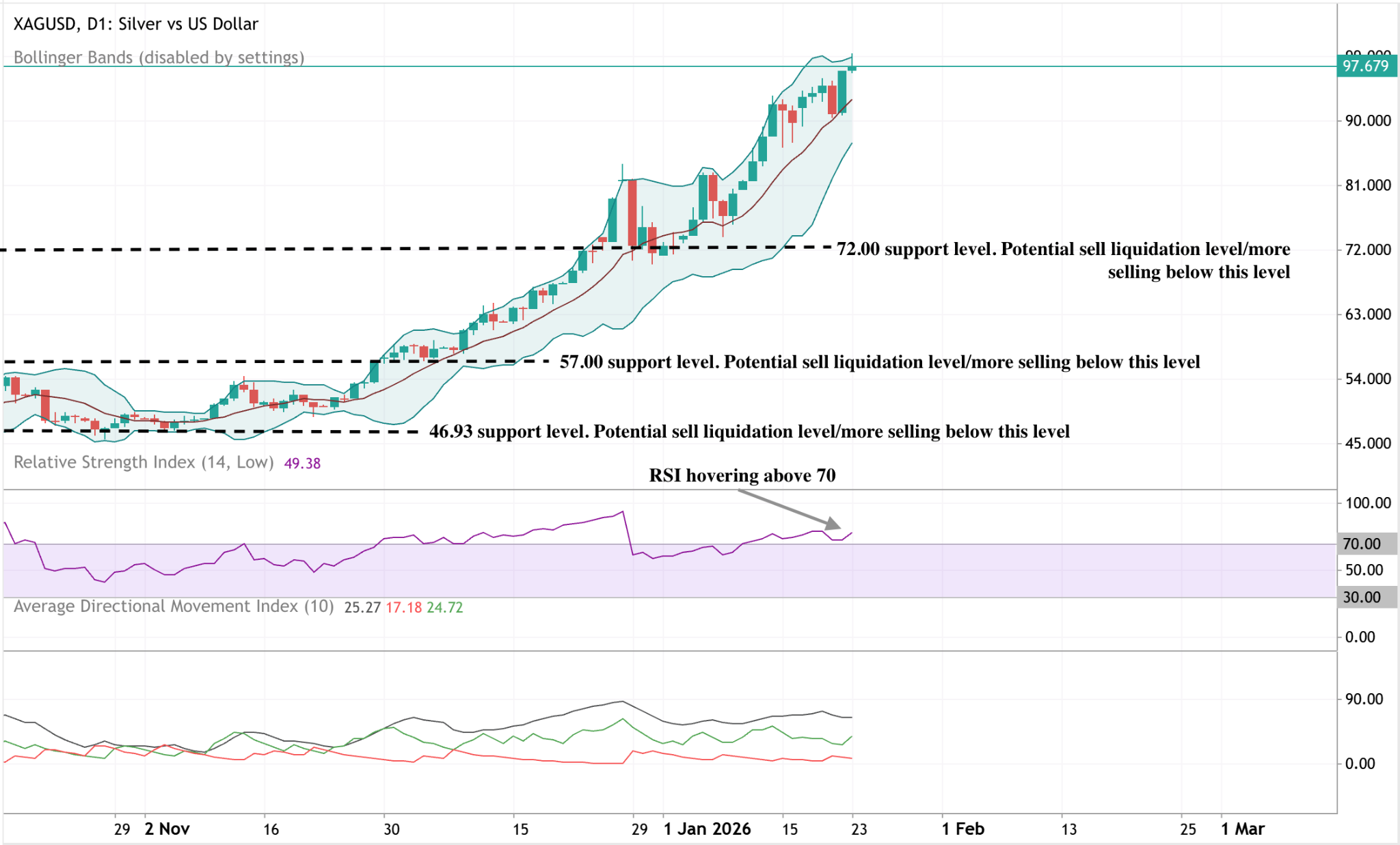
L’argent reste proche de ses récents sommets après une progression rapide et soutenue, le prix continuant d’évoluer près de la bande de Bollinger supérieure. Les bandes restent largement écartées, indiquant une volatilité élevée et une pression directionnelle persistante plutôt qu’une consolidation. Les indicateurs de momentum reflètent des conditions tendues : le RSI reste au-dessus de 70, signalant un momentum de surachat durable plutôt qu’un retour à la moyenne.
La force de la tendance demeure, avec un ADX élevé et des indicateurs directionnels montrant la domination continue du mouvement en cours. D’un point de vue structurel, l’argent se maintient bien au-dessus des anciennes zones de cassure autour de 72 $, 57 $ et 46,93 $, soulignant l’ampleur et la persistance du rallye récent. Dans l’ensemble, le comportement des prix reflète une phase de tendance prolongée caractérisée par un fort momentum et une volatilité accrue.
Les informations contenues sur le blog Deriv sont fournies à des fins éducatives uniquement et ne constituent pas des conseils financiers ou d’investissement. Ces informations peuvent devenir obsolètes, et certains produits ou plateformes mentionnés peuvent ne plus être proposés. Nous vous recommandons de faire vos propres recherches avant de prendre toute décision de trading. Les performances passées mentionnées ne garantissent pas les performances futures.


